

When it comes to inventory technology, more capability is not always better. While a regional distribution center processing tens of thousands of transactions a day may need specialized warehouse execution capabilities, a parts storeroom usually has relatively straightforward requirements. Put both use cases on the same Oracle inventory application and you’re stuck with a tough choice: give one too much complexity, or leave the other with not enough capability to support the work.
The risk of overbuilding includes adding implementation effort, administration, integrations, training, and process complexity without creating equivalent operational value. Meanwhile, underbuilding can lead to employees compensating for missing capabilities with spreadsheets, manual decisions, additional transaction steps, external applications, and other workarounds that increase work and make the operation harder to scale.
Your goal: match each facility with the combination of processes and technology that can produce the best operational outcome without adding complexity that doesn’t create value. Here’s how.
Know where each Oracle inventory solution generally fits
- Oracle Fusion Cloud Inventory Management is generally a good fit for stockrooms, storage locations, and other facilities where inventory activity is relatively predictable and warehouse complexity is limited. It provides support for core transactions such as inbound receiving and basic putaway, transfers and movements, cycle and physical counting, material issues and production receipts, and basic picking, packing, and shipping.
- Oracle Advanced Inventory Management fits moderately complex warehouse operations that need more structured execution than Inventory Management alone provides without requiring a full WMS. Additional capabilities include simple inventory task assignment and execution, single-level inventory license plate management, putaway suggestions, cross-docking opportunity notifications, outbound load creation, and shipment grouping.
- Oracle Warehouse Management Cloud is best suited to high-volume, operationally demanding facilities where warehouse execution is a core business capability. These operations may require advanced task management and interleaving, multi-level license plating, advanced picking and replenishment, rules-based slotting, cartonization, warehouse automation integration, or specialized 3PL capabilities such as managing customer-owned inventory and activity-based billing.
Facility type and size alone should not determine the application. A high-volume operation may still have relatively straightforward processes, while a lower-volume facility can have demanding automation, traceability, manufacturing, fulfillment, or inventory-handling requirements. Complexity is multidimensional, and the right solution should reflect how the operation actually works.
Look at what the operation actually requires
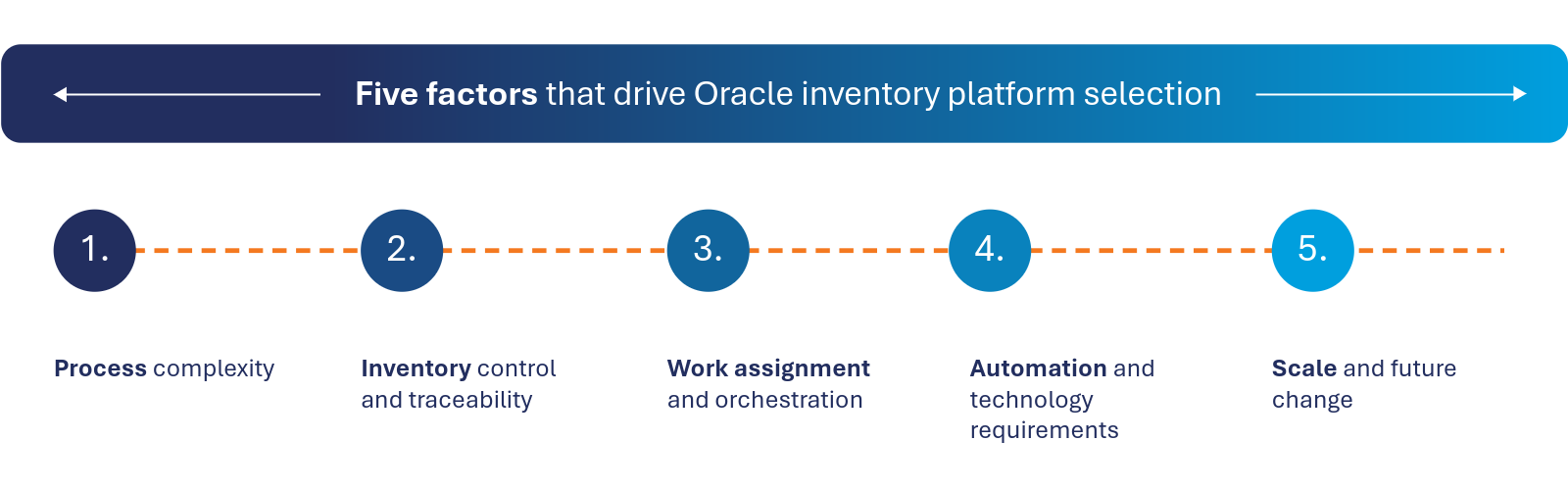
To determine which application fits, start with the operation itself. Evaluate the operation across several dimensions: process complexity, inventory control and traceability, work orchestration, automation and execution requirements, transaction volume and peak demand, and how those requirements are expected to change over time.
Consider how inventory needs to be controlled and tracked. Does the facility need inventory license plating? Are single-level license plates enough, or does it need multi-level container structures? What lot, serial, expiration, genealogy, or other traceability requirements must be supported?
The way work is assigned also matters. If supervisors or employees regularly decide what work should happen next, where it should happen, and who should perform it, the facility may benefit from greater system direction. As requirements move toward dynamic task assignment, task interleaving, cubing, more advanced warehouse automation, or very high transaction throughput, the case for a dedicated WMS becomes stronger.
Technology needs and future plans can change the fit as well. Material-handling equipment, automation, labeling, mobile devices, integrations, connectivity requirements, and customer-specific workflows should all be considered. So should expected growth, new fulfillment models, changing customer requirements, and other operational changes that may alter what the facility requires over the next several years.
One enterprise may need more than one solution
For organizations with several types of facilities, the right Oracle inventory strategy may deliberately include more than one application. For example, a single organization could have:
- A national distribution center with high transaction volumes, complex fulfillment, automation, and sophisticated warehouse execution that requires Oracle Warehouse Management Cloud
- A manufacturing plant with license plating and task assignment needs that are better suited for Oracle Advanced Inventory Management.
- Smaller parts storerooms with straightforward receiving, transfers, counts, and material issues that may only require Oracle Fusion Cloud Inventory Management.
That mixed architecture can be a strategic business advantage when each facility gets the capabilities it needs without forcing unnecessary complexity across the rest of the network.
But a mixed execution architecture doesn’t have to mean fragmented inventory management. Transaction ownership, integrations, and process design can be deliberately architected so inventory remains accurate and visible across the enterprise. The practical approach is to group facilities with similar purposes, transaction volumes, process complexity, automation, traceability, and workforce requirements into operational profiles, then map those profiles to the Oracle application that provides the right foundation for each type of operation.
Selecting the application is only one part of the equation
Even when the underlying Oracle application is the right one, the execution experience may still need to be adapted to the operation.
Some gaps can be addressed through process redesign, configuration, integration, or better implementation of native Oracle capabilities. Where the Oracle foundation is right but additional execution capabilities are required, FlexiPro™ can provide an enabling layer for mobile workflows, scanning and data capture, labeling, role-specific interfaces, and customer-specific processes. Across a mixed Oracle footprint, FlexiPro can also help create a more consistent frontline execution experience while allowing each facility to run the Oracle solution that best fits its operational needs.
The starting point remains the same: understand what the facility needs to accomplish, choose the Oracle platform that provides the right foundation, and then determine what configuration, services, or extensions are needed to make it work effectively.
Intellinum’s perspective is informed by supporting Oracle inventory operations across hundreds of customers and nearly half of the Oracle Warehouse Management Cloud install base, including more than 50 inventory go-lives in 2025 and the first Oracle Advanced Inventory Management customer to go live globally. Our experience shows that matching each facility to the processes, applications, and capabilities it actually needs allows our customers to improve performance and support growth without adding unnecessary complexity.
If you’re trying to determine which Oracle inventory application fits each part of your network, download Right-Sizing Your Oracle Inventory Strategy. You’ll learn how to evaluate Oracle Fusion Cloud Inventory Management, Oracle Advanced Inventory Management, and Oracle Warehouse Management Cloud against the requirements of each operation, along with where targeted extensions can help close remaining gaps.