

Warehousing, transportation, and trade compliance are often managed by different teams using different systems. However, the goods moving through your supply chain don’t recognize those boundaries. Connected Logistics is an operating approach designed around that reality.
This approach connects the processes, systems, data, and decisions across the logistics lifecycle so each function has the information it needs to act at the right time. For organizations using Oracle, that connected environment may include Oracle Warehouse Management System (WMS), Oracle Transportation Management (OTM), Oracle Global Trade Management (GTM), ERP, and relevant third-party systems, all working as parts of one broader logistics process rather than as standalone applications.
What Connected Logistics looks like in practice
In a Connected Logistics environment, data and events flow between functions at the point they are needed. For example, let’s look at what an outbound order moving through an Oracle logistics environment looks like when an organization follows a Connected Logistics approach:
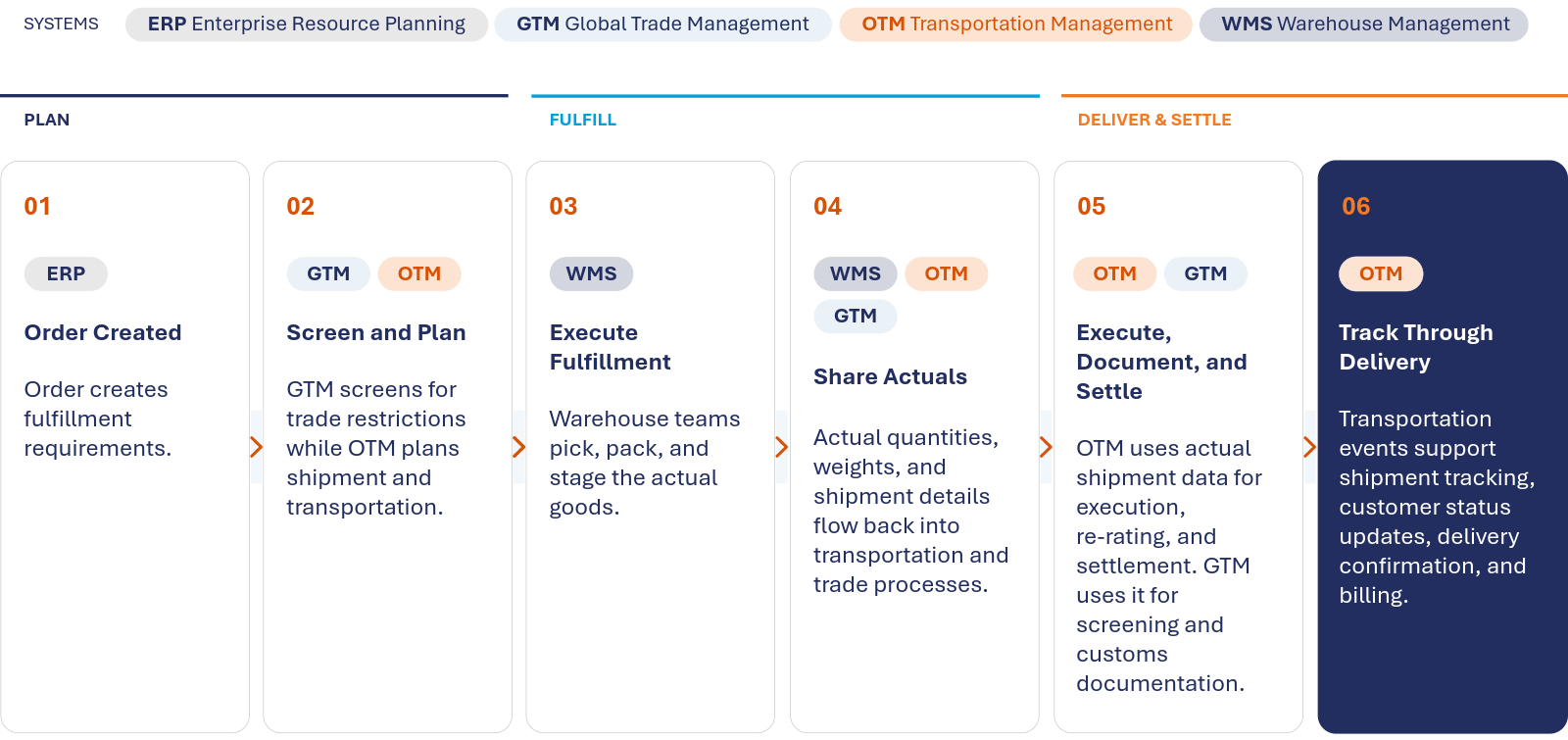
What makes the process connected isn’t just that the applications are exchanging transactions. It’s that each function receives the information it needs while there’s still time to act on it.
For example, if transportation identifies an inbound shipment that will arrive several hours late, that information has much greater value if the warehouse receives it before committing labor and dock capacity to the original arrival time. Similarly, actual shipment details coming out of the warehouse are more useful when transportation and trade compliance receive them before freight settlement or customs documentation is completed.
A Connected Logistics approach can help:
- Reduce manual handoffs and duplicate activities: Information can move directly between systems and functions instead of relying on spreadsheets, email, re-entry, and manual reconciliation.
- Increase visibility across orders, inventory, and shipments: Teams can see what’s happening across the warehouse, transportation, trade compliance, ERP, and external partners without piecing together status from separate applications.
- Improve exception response: Shipment delays, screening holds, inventory issues, and other exceptions can be identified earlier and routed to the people or systems best positioned to act.
- Provide cross-functional KPIs for a broader view of ROI: Measure outcomes across the broader process, such as end-to-end cycle time, cost to serve, or exception resolution.
- Deliver a stronger foundation for automation and AI: Shared, timely data and events give automation and AI enough context to identify anomalies, recommend actions, and support cross-functional agentic workflows.
Integration alone is not enough
Connecting applications is an important part of Connected Logistics, but technical integration alone doesn’t guarantee a connected process. Systems can exchange data successfully while teams still rely on manual workarounds, receive information too late to act on it, or remain unclear about which function owns the next decision. Creating a Connected Logistics environment requires answering questions that sit between the applications, such as:
- What information does the next function actually need?
- At what point in the process does it need it?
- Which application owns the data or event?
- What action should the information trigger?
- Who owns the decision if human intervention is required?
- What happens when the expected event does not occur?
- How should an exception be identified, routed, and resolved?
Those are business process decisions as much as technical ones. The integration architecture then needs to support those decisions through the appropriate combination of native application capabilities, middleware such as Oracle Integration Cloud, event-driven integrations, batch processes, or other approaches based on volume, latency, and workflow requirements.
Data consistency matters as well. An order, shipment, item, location, or status has to be identifiable across the participating applications. If your different systems are working from conflicting versions of the same transaction, connecting them may simply move bad or ambiguous information faster.
One important thing to keep in mind: Connected Logistics does not mean Oracle-only. You might use Oracle OTM and GTM with a non-Oracle warehouse platform. WMS may need to connect with SAP ERP. Carrier networks, suppliers, brokers, freight forwarders, visibility platforms, and homegrown applications may all participate in the same logistics flow. Connected Logistics is designed around your unique process, regardless of where every individual capability resides.
Think value first
Ultimately, Connected Logistics is about making warehousing, transportation, trade, ERP, and external partners operate as parts of a single business process. So where should you start?
Our recommendation: not all at once. Your starting point should reflect your organization’s greatest challenge or the area where you can unlock the highest or most immediate value. That may mean a WMS implementation, a transportation cost initiative, a trade compliance challenge, an ERP transformation, a visibility problem, or simply automating a manual handoff that creates disproportionate friction.
What matters is designing that first improvement with its upstream and downstream dependencies in mind so you solve the immediate problem without creating another isolated point solution. That is the Connected Logistics mindset: moving from optimizing individual applications to designing how information, decisions, and work move across the entire logistics lifecycle.
Want to see what Connected Logistics looks like in practice? Read The Connected Logistics Opportunity: Turning Your Oracle Investment into End-to-End Performance to learn where disconnected processes create the greatest business impact, how Connected Logistics works across Oracle and non-Oracle environments, and how to build a practical roadmap for getting started.