
Your warehouse operations are hitting their productivity targets, the transportation team has freight costs under control, and your trade compliance team is on top of keeping all your shipments compliant. So why does your overall logistics process still feel slower, more expensive, and harder to manage than it should be?
The problem is those functions don’t operate independently in the real world. Transportation decisions affect when goods arrive and how the warehouse plans labor and dock capacity. What happens in the warehouse affects transportation planning, rating, and settlement. Shipment details determine whether trade compliance has the information it needs to complete screening and customs documentation.
When those functions are optimized separately, the gaps between them are easy to miss. This challenge is especially common when organizations have invested in multiple logistics applications over time. While an initial implementation may address the most immediate requirements, it’s not uncommon to see important capabilities remain underused while key processes stay disconnected. You may own the right technology and still not use it in a way that supports the broader logistics process or the business outcomes you are trying to achieve.
To improve the overall process, you have to look beyond how each function performs on its own and examine what happens between them.
How value gets lost between functions
The biggest performance gaps often show up in the handoffs between systems:
- An inbound shipment is running late, but time, labor, and dock capacity may still be planned around the original arrival if that update doesn’t reach the warehouse.
- The warehouse knows what was actually picked, packed, and staged, but transportation may still be working from planned shipment details when it comes time to re-rate the load or settle freight.
- A shipment may be delayed at customs because trade compliance didn’t receive complete or accurate data early enough to prepare the required documentation.
When your individual logistics applications don’t carry that information forward, people usually have to use spreadsheets, email, phone calls, duplicate data entry, and manual reconciliation to keep the process moving. External suppliers, carriers, brokers, and forwarders introduce another layer of coordination when information also has to move between internal systems and external partners.
Those workarounds may keep an individual shipment on track. But at scale, they add labor, slow decisions, increase the risk of errors, and make it harder to see where the process is actually breaking down. Siloed performance measures can make the problem even harder to see. Each function can hit its productivity targets or cost goals while the broader process still misses customer commitments or creates unnecessary costs. If each function is measured only within its own boundaries, the cumulative impact of delays, rework, and exceptions across the full logistics flow can remain hidden.
Look beyond the symptom
The first step is to stop assuming that the function where a problem appears is also where it begins and ends. That means troubleshooting and optimization have to follow the process upstream and downstream. Instead of asking only how to improve warehouse, transportation, or trade compliance performance, look at what information each function depends on, when that information becomes available, which system owns it, and what happens if it arrives late or incomplete.
This broader view also changes how you think about value. Fixing one broken connection can create benefits across several functions at once: better transportation visibility can improve warehouse planning, more accurate warehouse execution data can improve freight settlement, and better shipment information can reduce compliance delays. The business case should account for those downstream effects, not just the improvement inside the application where the project started.
The Connected Logistics opportunity
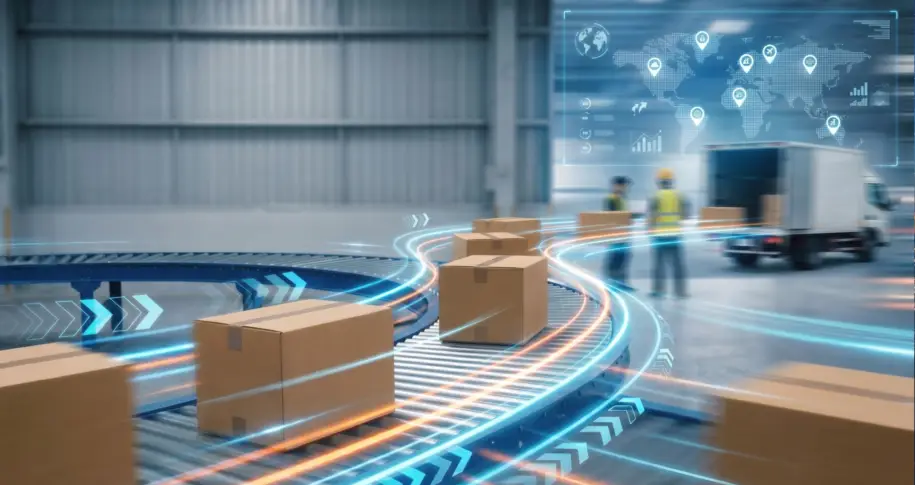
Improving logistics performance requires looking at how information, decisions, and work move across the warehouse, transportation, trade compliance, ERP, and the external systems and partners involved in the process.
That’s the idea behind a Connected Logistics approach. Instead of treating warehousing, transportation, and trade compliance as separate optimization projects, you design the processes, data, and decisions between them as part of one broader logistics flow. That includes determining which system owns critical information, when another function needs it, what event should trigger the next action, and how exceptions should be handled when the expected process breaks down. For organizations using Oracle, that connected environment may include Oracle WMS, OTM, GTM, Fusion ERP, and relevant third-party systems.
Connecting those processes also gives you a broader way to measure logistics performance. Metrics such as total landed cost, cost to serve, end-to-end order-to-delivery cycle time, and perfect order rate depend on information that spans multiple functions. When that data is fragmented, those measures can be difficult and time-consuming to assemble. A Connected Logistics approach makes cross-functional performance easier to measure and act on, helping you see opportunities that siloed KPIs can miss.
A more connected approach can also simplify how information moves beyond your four walls. Instead of maintaining separate or redundant connections with carriers, suppliers, brokers, and forwarders, the appropriate logistics application can serve as the primary connection point for that part of the process. That can reduce integration complexity while giving external partners and internal teams a more consistent flow of information.
As those connections improve, the benefits can extend beyond the function where the work started. Connected data can make it easier to measure outcomes across functions that siloed KPIs may not reveal, respond to exceptions earlier, and provide a stronger foundation for automation and AI.
Optimizing your warehouse, transportation, or trade compliance systems individually can still produce meaningful gains. But some of the biggest opportunities may sit outside the boundaries of any one application. By looking at how information, decisions, and work move between functions, you can identify the gaps creating unnecessary cost and get more value from the Oracle investments you already have.
Want to see what Connected Logistics looks like in practice? Read The Connected Logistics Opportunity: Turning Your Oracle Investment into End-to-End Performance to learn where disconnected processes create the greatest business impact, how Connected Logistics works across Oracle WMS, OTM, GTM, and ERP, and how to build a practical roadmap for getting started.